Institute Paper No. 3
Institute for Craft Formation
Manual Intelligence and the Cortical Map
The Role of the Human Hand in Cognitive Development
Author: Stephen Critchley
Founder, Institute for Craft Formation
Human intelligence is often discussed in terms of abstract reasoning, memory, and analytical thought. Yet a fundamental aspect of human cognition lies in a far older and more physical system: the hand.
From an evolutionary perspective, the human hand is one of the most significant drivers of neurological development. The motor cortex—the region of the brain responsible for voluntary movement—allocates a disproportionately large area to controlling the hands and fingers. This neurological investment reflects the central role that manual interaction has played in shaping human intelligence.
Traditional craft disciplines operate directly within this neurological architecture.
By requiring precise interaction with materials, tools, and physical forces, craft practices activate and refine neural systems associated with perception, coordination, and judgement. Over time, these interactions cultivate a form of cognition that can be described as manual intelligence.
The Hand as an Interface with Reality
The hand is not merely an instrument for executing instructions from the brain. It is a sensory organ capable of receiving complex information about the physical world.
Through touch, pressure, vibration, and resistance, the hands transmit continuous streams of data to the nervous system. These signals allow the brain to construct an understanding of material behaviour, texture, weight, and structural stability.
In traditional craft environments this feedback is constant.
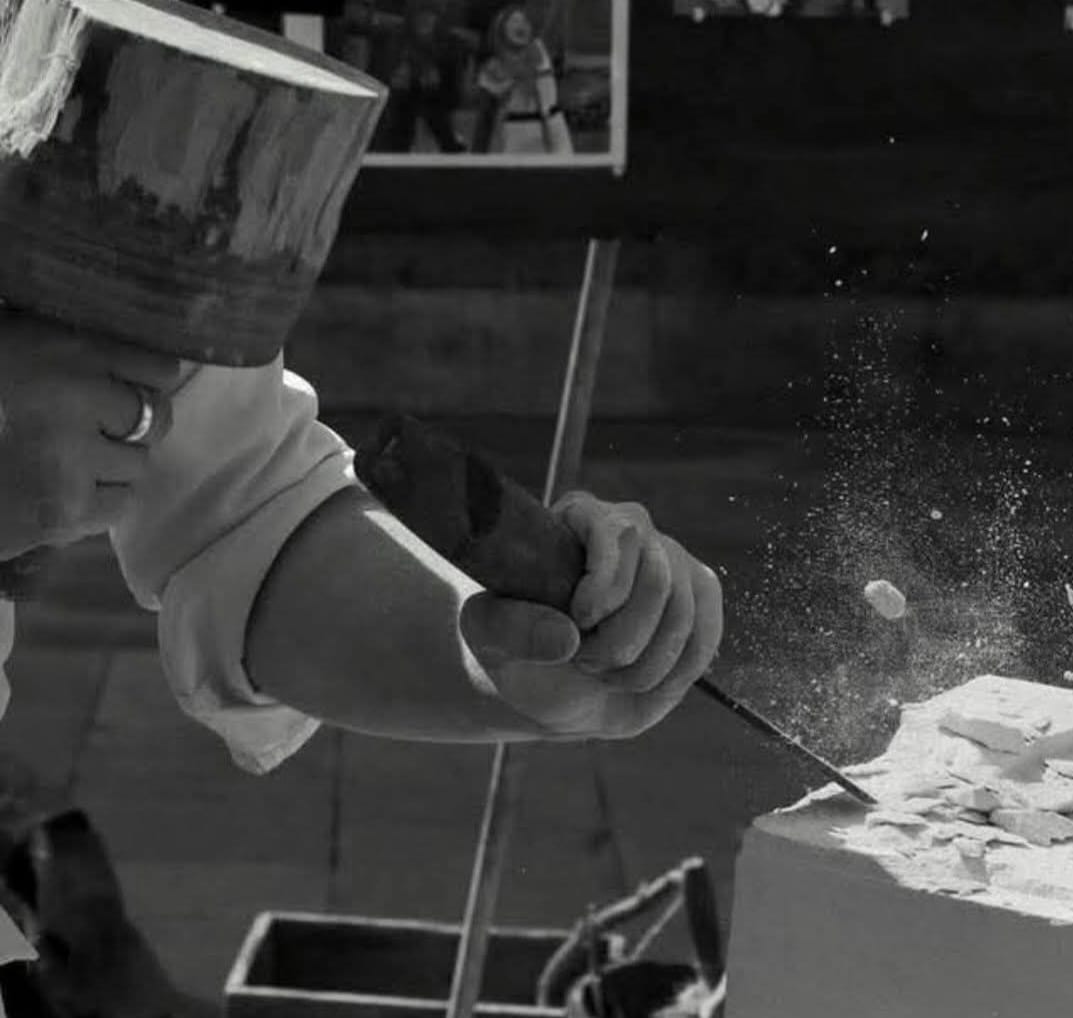
A stone carver, for example, receives tactile information through the handle of the mallet, the shaft of the chisel, and the vibration transmitted through the material itself. The craftsman must interpret these signals instantly and adjust movement accordingly.
This process creates a continuous loop of perception and action.
The brain interprets the signal.
The hand responds.
The material provides feedback.
The cycle repeats.
Over time, this loop refines both physical skill and cognitive judgement.
Precision and Consequence
One of the defining characteristics of traditional craft disciplines is the presence of irreversible consequence.
When carving stone, a misplaced strike cannot easily be undone. Each action must therefore be deliberate and controlled. The craftsman learns to pause, observe, and calculate before committing to movement.
This environment cultivates a particular relationship between thought and action.
Rather than acting impulsively, the practitioner develops a habit of measured response. Decisions are tested mentally before being executed physically. This pattern strengthens the connection between perception, planning, and movement.
In this sense, manual craft becomes a training ground for disciplined cognition.
Manual Work and Spatial Reasoning
Craft disciplines also engage the brain’s spatial reasoning systems.
Stone carving, architectural drawing, and traditional building crafts require the practitioner to visualize complex forms in three dimensions. The craftsman must understand how a structure will emerge from a block of material before the first strike is made.
This ability to imagine form within material develops through repeated interaction with real objects rather than through abstract diagrams alone.
The hands guide the process while the mind maintains a mental model of the structure being created.
Over time, this relationship between hand and mind strengthens the brain’s ability to process spatial information—a capacity essential not only in craft but also in architecture, engineering, and design.
The Decline of Manual Engagement
Modern professional environments have dramatically reduced the role of manual interaction in daily cognitive life.
Many forms of work now occur entirely within digital systems. The hands perform limited movements on keyboards or touchscreens, and the majority of problem-solving takes place within abstract symbolic frameworks.
While such environments enable rapid communication and analysis, they provide far less tactile feedback than traditional material practices.
The reduction of manual engagement may therefore represent a significant change in the conditions under which human cognition develops.
Craft as a Training Environment
Traditional craft disciplines offer a different cognitive environment.
They require continuous interaction with materials that respond immediately to physical force. The practitioner must interpret tactile feedback, regulate movement, and maintain concentration throughout the process.
This environment stimulates neurological systems associated with attention, coordination, and spatial reasoning.
Manual intelligence therefore emerges not as a separate faculty but as a component of integrated cognition.
The hand becomes both a sensor and an instrument of thought.
Conclusion
Manual intelligence represents an important dimension of human cognition that has often been overlooked in modern discussions of intellectual development.
Traditional craft disciplines demonstrate that the hand plays a central role in shaping perception, judgement, and spatial reasoning.
Through continuous interaction with resistant materials, craftsmen cultivate a neurological feedback loop that integrates perception, planning, and movement.
Understanding this relationship between hand and mind may offer valuable insight into how human intelligence has historically developed—and how elements of that development might be preserved within contemporary life.