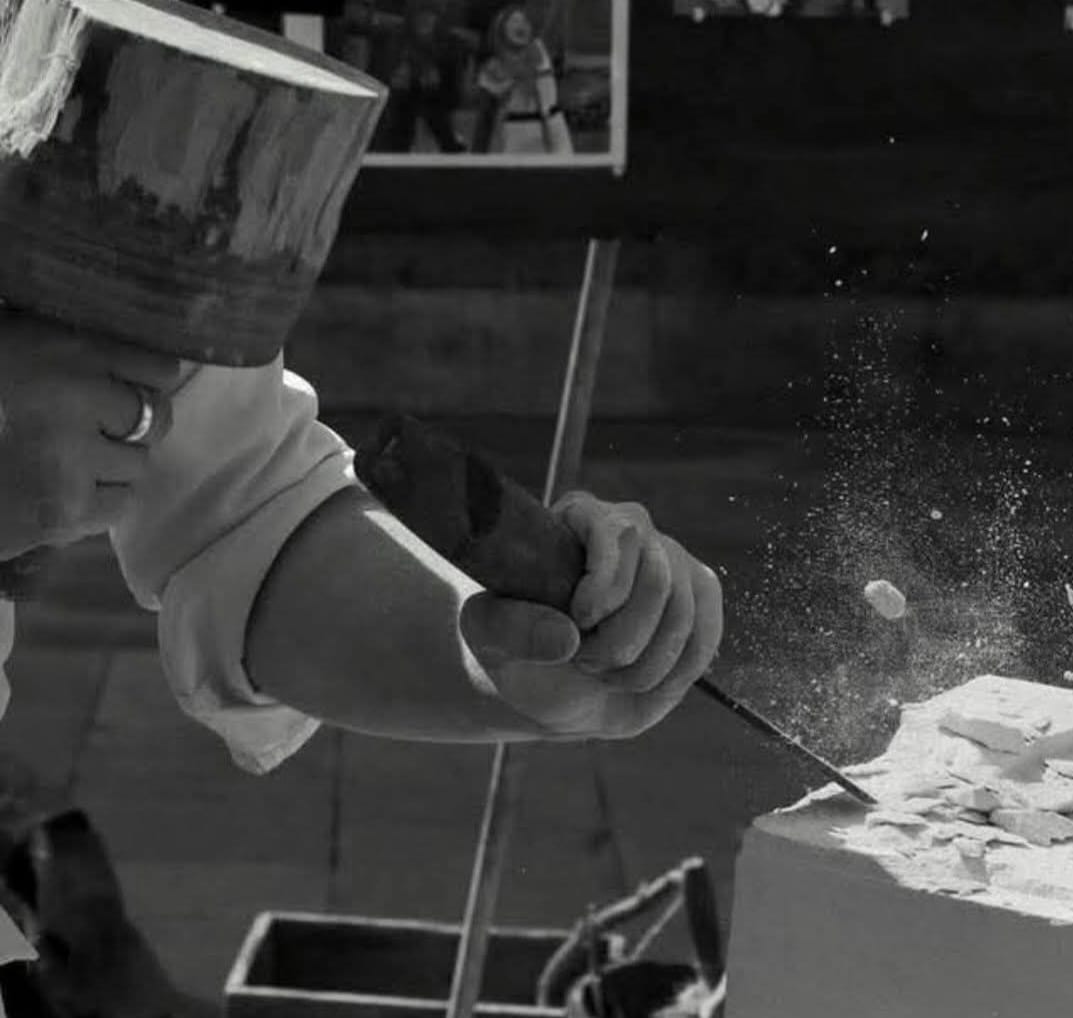
Category: Court Master Carving
-
When one walks through the hushed corridors of the Ashmolean Museum, the eye is naturally drawn to the masterpieces on canvas. Yet, for a carver, the true revelation often lies at the periphery. There is a particular frame within those walls—carved by the incomparable Grinling Gibbons—that serves as a silent testament to a level of…
-
In my teachings and during our retreats, I often speak of the “architecture of the self.” This is not a metaphor I chose lightly. It is a philosophy I learned with my own hands while working on the great monuments of the English Renaissance—buildings designed by the masters Inigo Jones and Sir Christopher Wren. The…
-
As a child in the aftermath of the Second World War, my world was defined by the jagged geometry of the City’s bomb sites. To most, these were merely ruins; to me, they were my first playgrounds. I climbed through the exposed foundations and scorched timbers of a London that had stood since the Great…
-
There is a particular kind of stillness that settles over a historic building site before the public arrives—a brief window where the dust of the masons and the precision of the architecture exist in perfect, silent alignment. Looking back on the year 2000, while working as Head of Masonry and Conservation with St Blaise Ltd…
-
To understand the 2005 commission for the Cannes and Perpignan centres, one must look further back to the foundations of my practice in Knightsbridge, London. It was there, while attending to the residential requirements of Middle Eastern royalty, that I first refined the application of “The Renaissance Proportion” for a discerning elite. Serving a royal…
-
In an era of “disposable” culture and digital ephemera, Courtmaster Carving stands for the enduring. We believe that a life well-crafted must be built on a foundation of substance. To understand how an artist can imbue a flat surface with the physical gravity of stone, we look to Johannes Vermeer’s View of Delft. The Secret…
-
In the craft of stone carving, we often say that the sculpture is defined by the stone that is removed. The “negative space” is what allows the form to exist. This concept is a pillar of Court master Carving, and there is no greater allegory for this in the art world than the missing panel…
-
There is a particular quiet that settles over the workshop when the mallet meets the stone. It is a silence not of absence, but of profound presence. Beyond the reach of the virtual, this ancient craft stands as a tangible anchor to the absolute. At Courtmaster Carving, we observe a specific transformation: the moment an…
-
In the modern world, attention has become a fractured commodity, pulled apart by a thousand digital demands. At Court Master Carving, we offer an alternative: a return to the Geometry of Silence. To understand this state of being, one must look closely at Johannes Vermeer’s The Lacemaker. It is a work that does not merely…