Tairseach
The Threshold
The older Irish world did not divide existence as sharply as the modern one.
Stone, water, music, language, memory, landscape, spirit, death, ancestry, and daily life were not understood as separate territories. They moved into one another continuously, and because of this, the places where one condition became another held enormous importance.
These places of crossing were thresholds.
In Irish:
Tairseach.
The threshold was not simply an entrance. It was a place where the fabric of the world became thinner, less fixed, more open to movement between states of being.
Much of the older Irish belief system was built around this understanding.
A cave was not only shelter or geology. It was an opening into the underworld beneath the land. Certain caves, hollows, and mounds were believed to connect directly to the world of the dead, the ancestral world, or the Otherworld — the unseen reality existing alongside ordinary life.
The sidhe mounds of Ireland were understood not as myths in the modern sense, but as real points of crossing between worlds. The beings associated with them — the Aos Sí — belonged neither fully to this world nor entirely beyond it.
Water carried the same meaning.
A ford across a river was dangerous not merely physically, but spiritually. It represented transition itself: neither one bank nor the other, neither stable land nor open water. Lakes, wells, springs, and river crossings repeatedly appear in Irish tradition as places of vision, healing, encounter, danger, or transformation.
The edge of woodland was another threshold.
In early Irish thought, cultivated land represented ordered human existence. Forest represented the older and less controlled world beyond human structure. To pass beneath trees was to enter another condition of awareness where ordinary rules weakened.
Mist, twilight, islands, mountain passes, shorelines, caves, burial mounds, wells, and crossings all shared this same quality:
they existed between worlds.
The old Irish sacred landscape was therefore not organised around isolated holy objects alone, but around movements between conditions.
This understanding shaped Irish artistic traditions profoundly.
The great carved crosses of Ireland were not simply memorials or markers. They often stood along sacred routes, near monastic boundaries, or at points of transition between ordinary ground and consecrated space. The cross itself became a threshold: between earth and heaven, body and spirit, mortality and eternity.
Likewise, carving itself was not treated merely as decoration.
Pattern, rhythm, repetition, shadow, geometry, proportion, colour, sound, and movement all worked together to alter perception.
This principle survives throughout Irish carving traditions:
spirals turning endlessly inward and outward,
interlace without beginning or end,
repeated geometric systems,
figures emerging from shadow,
compressed and released rhythm within the surface itself.
These were not simply visual devices.
They reflected a deeper belief that ordered pattern could move the human mind beyond ordinary awareness.
The same principles existed in Irish poetry and music.
The old Irish poets — the filí — occupied a role far greater than entertainment. They preserved memory, genealogy, law, mythology, cosmology, and sacred knowledge. Poetry was understood as something capable of transformation.
Words carried force.
Rhythm carried force.
Repetition carried force.
The voice itself could become a threshold.
The old Irish concept of Imbas Forosnai referred to illuminated or visionary inspiration — a form of deep insight reached through disciplined poetic practice and altered states of consciousness. This was not imagination in the modern casual sense. It was considered a genuine movement beyond ordinary perception.
Traditional Irish music retains much of this older structure.
Repetition, return, variation, suspension, release, accumulation of rhythm — these can gradually alter awareness in exactly the same way carved rhythm alters the eye moving across stone.
The old Irish traditions repeatedly return to the same underlying principle:
that transformation happens at crossings.
Not in fixed certainty, but in movement between states.
Between land and water.
Between light and shadow.
Between silence and sound.
Between life and death.
Between memory and presence.
Between the human world and the unseen world beside it.
This understanding continued into Christian Ireland rather than disappearing entirely. Many of the older sacred patterns remained beneath the surface of monastic culture, carving traditions, pilgrimage routes, holy wells, devotional practice, poetry, and music.
The threshold remained central.
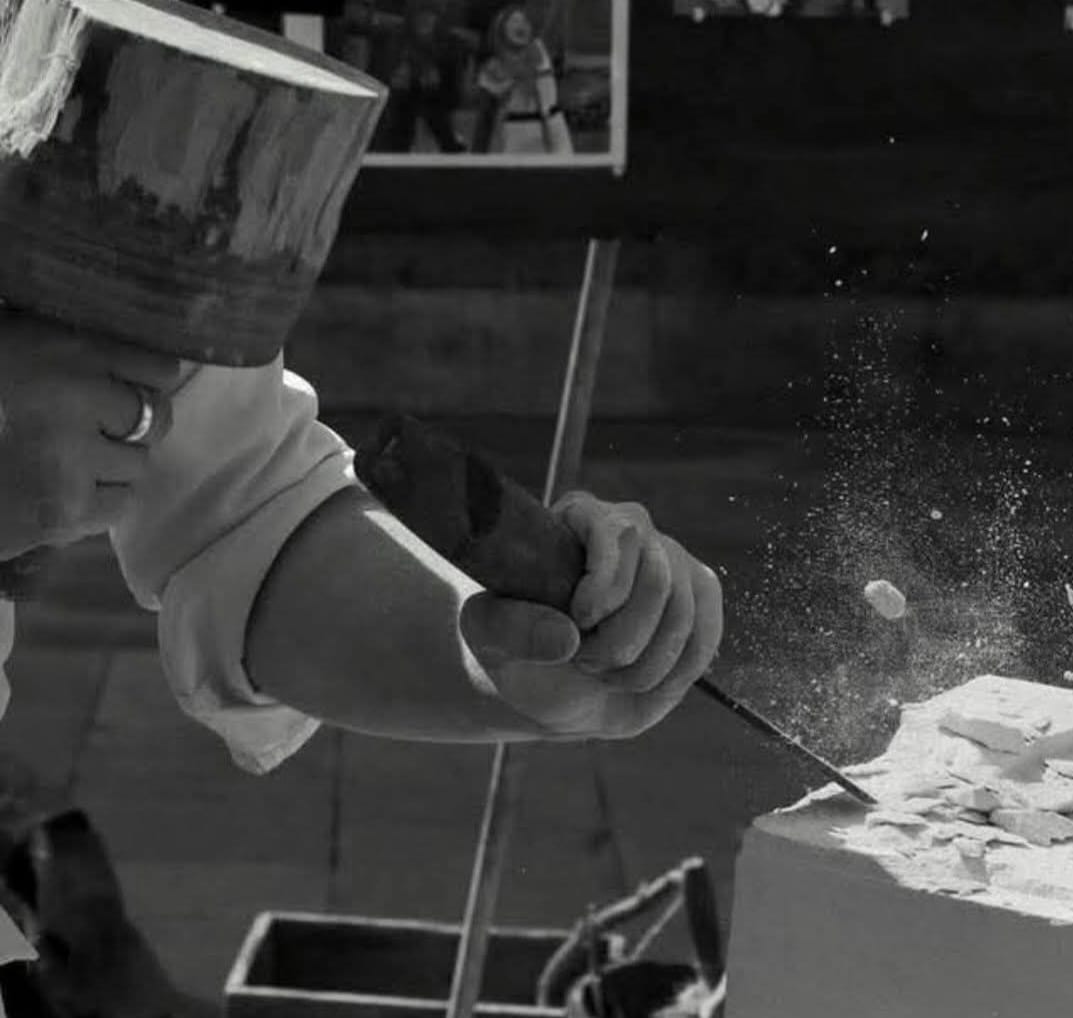
This is the tradition within which I work.
Not as historical reconstruction or performance, but as a living continuation of older Irish ways of understanding rhythm, carving, material, symbol, perception, and transformation.
My work moves through sculpture, carving, sacred form, landscape memory, poetry, rhythm, and the older stone traditions of Ireland because historically these things were never truly separate from one another.
A carved figure can become a threshold.
A cross can become a threshold.
A poem can become a threshold.
A melody can become a threshold.
A cave can become a threshold.
A passage into shadow can become a threshold.
The work is not only about objects.
It is about crossings.