Institute Paper No. 4
Institute for Craft Formation
The Craft Longevity Principle
Architecture as Cognitive Training: Spatial Reasoning in Traditional Craft Disciplines
Author: Stephen Critchley
Founder, Institute for Craft Formation
Architecture has historically required forms of thinking that differ from purely abstract intellectual activity. Unlike symbolic systems that exist primarily on paper or within digital environments, architecture exists in three dimensions and must interact with gravity, material resistance, and structural forces.
Traditional craft disciplines therefore demanded a continuous form of spatial reasoning.
The master builder, mason, or architectural carver was required to understand how volumes, loads, proportions, and structural relationships interacted within physical space. Decisions were rarely isolated technical problems; they were spatial judgements embedded within a larger architectural system.
Within this environment the craftsman developed the ability to visualize structures not only as drawings but as physical forms occupying real space.
This ability did not arise through theoretical instruction alone.
It developed through continuous interaction with material.
Thinking in Three Dimensions
Traditional craft work requires the practitioner to think simultaneously in multiple spatial layers.
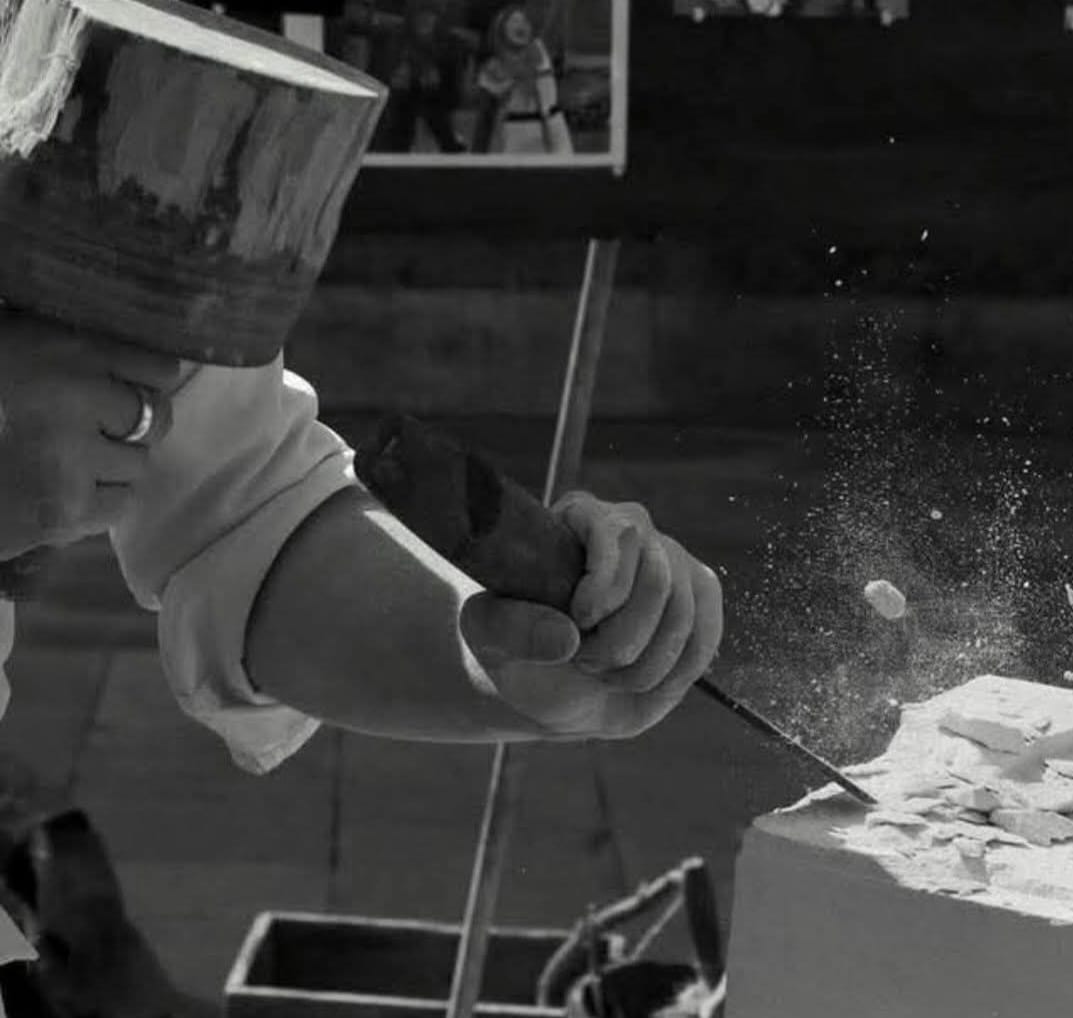
When carving stone, for example, the craftsman must visualize the final form within a solid block of material before the work begins. Each strike of the tool removes material permanently, gradually revealing the structure that has been mentally projected.
The practitioner must therefore maintain a mental model of the finished form while working on a small area of the surface.
This process requires constant spatial translation.
The craftsman observes the physical surface.
The mind reconstructs the underlying volume.
The hand executes the next stage of removal.
The process repeats continuously.
Over time this interaction strengthens the brain’s capacity to visualize complex three-dimensional structures.
This ability is not merely artistic. It is structural.
It allows the craftsman to anticipate how material will behave as form emerges.
Proportion and Geometric Judgement
Traditional architecture also required a deep understanding of proportion.
Classical building traditions relied upon geometric systems that governed the relationships between elements within a structure. Columns, capitals, mouldings, and architectural ornaments followed precise proportional relationships developed through centuries of practice.
The craftsman therefore worked within a geometric language.
Rather than copying shapes mechanically, the practitioner learned to recognise and reproduce proportional relationships directly within material. The eye became trained to detect subtle variations in alignment, curvature, and symmetry.
This ability developed gradually through repeated practice.
Over time the craftsman internalized the proportional system so thoroughly that it could be applied instinctively.
Judgement of proportion became a form of trained perception rather than a calculation performed consciously.
Material Awareness and Structural Thinking
Working within architecture also required awareness of structural behaviour.
Stone, timber, and other building materials respond to weight, pressure, and environmental forces. The craftsman must therefore understand not only the visual form of an element but also its structural role within the building.
A decorative carving, for example, cannot compromise the strength of the material supporting it. The craftsman must balance aesthetic intention with structural stability.
This requirement creates an environment in which artistic judgement and engineering awareness operate together.
The practitioner learns to evaluate form not only for its appearance but also for its structural implications.
Such training develops a form of thinking in which visual perception, mechanical reasoning, and spatial imagination operate as a unified process.
Craft as Spatial Training
Traditional craft disciplines therefore function as environments of continuous spatial training.
Every action requires the practitioner to interpret the relationship between material, geometry, and structure. The hands operate on the surface of the material while the mind maintains awareness of the three-dimensional form emerging within it.
This interaction gradually strengthens the brain’s capacity for spatial reasoning.
The practitioner becomes capable of visualizing complex structures, anticipating structural behaviour, and maintaining awareness of form at multiple scales simultaneously.
These abilities are essential not only in architecture but also in many other fields that depend upon spatial understanding.
The Decline of Spatial Engagement
Modern professional environments often involve less direct interaction with physical structures.
Much contemporary work occurs within symbolic systems, digital interfaces, or abstract conceptual models. While these systems allow complex information to be processed efficiently, they rarely require sustained engagement with three-dimensional materials.
As a result, opportunities for developing spatial cognition through physical practice have become less common.
Traditional craft disciplines therefore offer a valuable perspective.
They demonstrate how spatial reasoning can develop through sustained interaction with material environments rather than through abstract modelling alone.
Conclusion
Architecture and traditional building crafts provide one of the clearest historical examples of spatial cognition developed through physical practice.
By working directly with materials, geometry, and structural forces, craftsmen cultivate the ability to visualize complex forms, judge proportion accurately, and anticipate structural behaviour.
These abilities emerge not from abstract theory alone but from repeated interaction between mind, hand, and material.
Understanding how traditional craft disciplines develop spatial reasoning may offer important insights into the broader relationship between physical practice and human cognition.