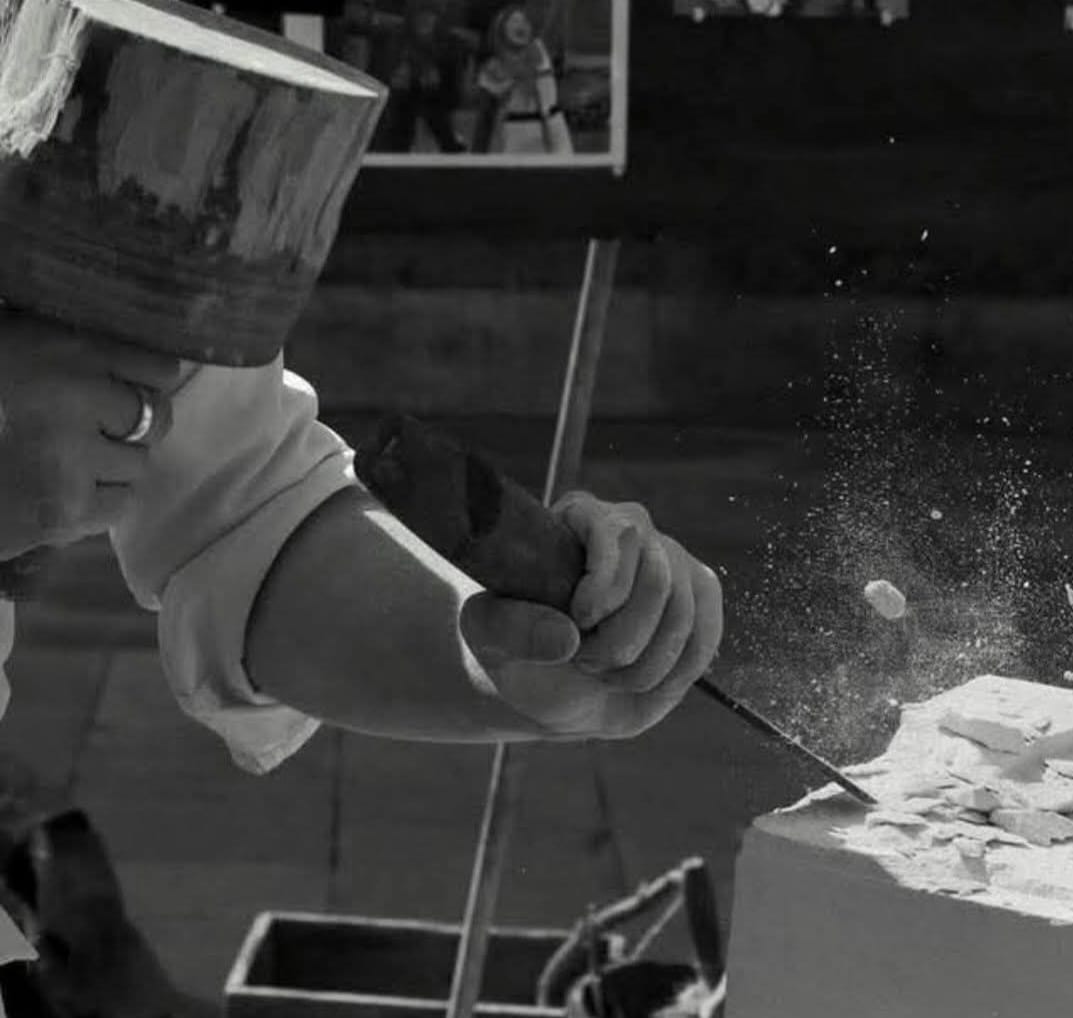
In the lineage of a creative life, there is often a single point of departure that defines the horizon. For me, that moment arrived over twenty years ago with my fourth masterpiece. It was a physical interrogation of Jacques Brel’s 1959 recording of “Ne me quitte pas,” rendered in marble. It represented a seismic shift in my evolution, propelling me from the realm of high-end craftsmanship into the role of a master.
To carve the essence of that song was to engage with the very anatomy of desperation, using advanced musical theory as the primary chisel for my soul.
The Rhythm of Obsession: Ostinato and Meter
The foundation of this work was the ostinato—the relentless, rhythmic repetition of the title phrase. In Brel’s composition, the ostinato serves as a psychological tether, a persistent 3/4 time signature that mimics the frantic waltz of a breaking heart.
In the stone, I interpreted the four-syllable pulse of the French—Ne-me-quitte-pas—as a percussive heartbeat. This rhythmic anchor provided the discipline required to contain the mounting “folie” of the lyrics. By adhering to this strict meter within the material, I was able to explore agogic accents—the subtle variations in duration that emphasize certain peaks in the stone, mirroring how Brel stresses the word “quitte” to signify the sharp pain of departure.
The Architecture of the Slur: Portamento and Appoggiatura
A central achievement of this fourth piece was the translation of the portamento. This is the vocal technique where Brel “carries” his voice from one pitch to another in a seamless, liquid slide.
To render this in stone—a medium defined by its rigidity—I developed a technique of “slurred” surfaces and liquid geometry. The eye is led effortlessly from high relief to low void, capturing the microtonal space between notes. This is further complicated by the appoggiatura—the “leaning note” that creates a temporary dissonance before resolving into the harmony. In my work, this appears as a physical tension, a protrusion in the stone that seems to lean into the next curve, demanding a resolution that only the viewer’s eye can provide.
Chromaticism and the Folie of Form
The “folie” explored in this early masterpiece mirrors the song’s use of chromaticism—the use of notes outside the standard scale to create instability. In stone, this translated to “interrupted lines” and unexpected shifts in the depth of the relief.
We also find the presence of the internal tempo rubato, where the melody pushes and pulls against the metronome. This signature technique—allowing the stone to “breathe” against the formal constraints of the design—is what I now share with those who attend my retreats. It is the mastery of the ritardando, the gradual slowing of the visual pace as the carving nears its conclusion, that brings the observer to a state of profound stillness.
Subtractive Form: The Fermata of the Void
The most significant element of this work is the use of subtractive form to represent the fermata—the mark indicating a note or rest should be held beyond its duration.
In the final movements of the stone, I utilized the void to represent these held moments of silence. Just as Brel allows the music to drop away, leaving only the breath of the listener, the sculpture uses negative space to hold the viewer in suspension. To carve the silence out of solid rock is the ultimate testament to the master’s hand.
The Sanctum of the Retreat
While my commissions allow me to explore these depths for a private and discerning patronage, my retreats exist as a separate, dedicated sanctum. They are a space for the transmission of the craft itself—a pure environment where I can pass on these foundational philosophies of sound and stone to those who seek to understand the journey from Master craftsman to Court Master carver.
INITIATE QUALIFICATION
This is the formal point of entry for all commissions, residencies, and consultations. To discuss a project or request a place in the Yard, you must first define the scope of your intent.
Begin Qualification
Leave a Reply