Washington, D.C. is a city of power, secrets, and iconic imagery. But it was during a recent re-watch of The Blacklist, while Agent Keen and Reddington navigated yet another labyrinth of deception against the backdrop of the D.C. skyline, that a particular architectural truth dawned on me. As the camera panned over the familiar dome of the United States Capitol, I felt a distinct “jarring” of the senses—a visual dissonance that one simply does not encounter when gazing upon the Pantheon in Rome, the Duomo in Florence, or St. Paul’s in London.

On the surface, they all share the same vocabulary: the majestic curve, the soaring height, the classical authority. Yet, the Capitol feels fundamentally “wrong” to the trained eye. After some reflection, and perhaps influenced by Red’s own lessons in identifying hidden truths, I believe this unease stems from three distinct architectural “dishonesties.”
The Illusion of Weight (A Grand Deception)
The great domes of the Old World—the Pantheon and Florence’s Duomo—are triumphs of masonry. They are built of stone, brick, and Roman concrete. Their visual weight is honest; you can feel the immense gravity pushing down into the earth.
The U.S. Capitol, however, performs a theatrical trick worthy of a Reddington monologue. It is not stone at all, but nearly 4,000 tonnes of cast iron, painted meticulously to mimic the white marble below. Because iron is far stronger and lighter than stone, it allows for a height and thinness that would be physically impossible in masonry. To our subconscious, the dome looks “impossibly” large for the walls supporting it. It is an industrial machine dressed in a silk gown, and the eye, much like a seasoned operative, senses the ruse.
The “Giant Hat” Proportion (A Misfit Crown)
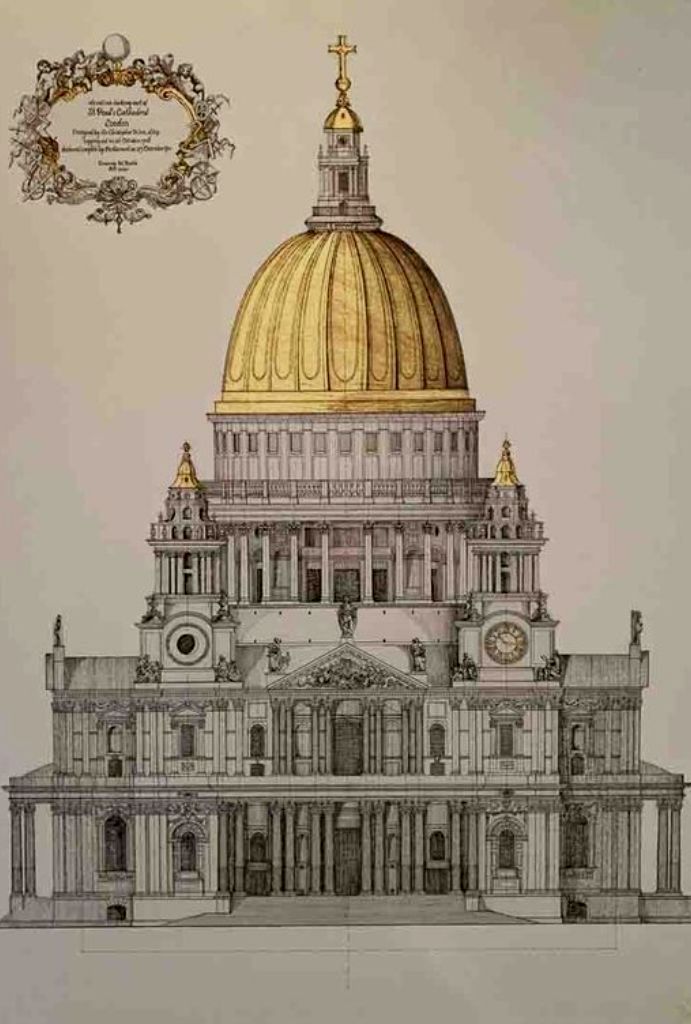
Architectural beauty often relies on the relationship between the “drum” (the base) and the “cupola” (the cap).
- The Pantheon is a perfect hemisphere, snug and grounded.
- St. Paul’s uses a sophisticated triple-shell design to balance its internal beauty with its external height.
The Capitol, by contrast, suffered from being an afterthought. The current dome was added decades after the original building was finished to satisfy a 19th-century desire for “grandeur.” The result is a two-story “wedding cake” drum that makes the dome appear top-heavy—less like a crown and more like a giant hat placed upon a man whose shoulders are slightly too narrow to carry it. It’s a proportion that screams “performance” rather than “perfection.”
The Mechanical Curve (Lacking the Human Touch)
In the masterworks of Brunelleschi or Wren, one finds entasis—the subtle, organic swelling of lines that mimics the vitality of nature. These domes feel sculpted, imbued with a human touch. The Capitol dome, born of the Industrial Revolution, was constructed from prefabricated iron parts. Its profile is precise, mechanical, and somewhat stiff. It lacks the “breath” of hand-carved stone, resulting in a silhouette that feels more like a product of a factory than a work of high art—a stark contrast to the organic forms Red often praises in his musings on history and craftsmanship.
INITIATE QUALIFICATION
This is the formal point of entry for all commissions, residencies, and consultations. To discuss a project or request a place in the Yard, you must first define the scope of your intent.
Begin Qualification
Leave a Reply