In the modern world, attention has become a fractured commodity, pulled apart by a thousand digital demands. At Court Master Carving, we offer an alternative: a return to the Geometry of Silence. To understand this state of being, one must look closely at Johannes Vermeer’s The Lacemaker. It is a work that does not merely depict a craft; it embodies the very essence of Active Contemplation.
The Optical Anchor: The Wisdom of the Blur
Vermeer was a master of “optical truth.” He often utilized a Camera Obscura to study how the human eye truly perceives the world. If you examine the foreground of The Lacemaker, you will notice something revolutionary for the 17th century: the red and white silk threads pouring from the cushion are blurred.
Vermeer used pointillés—tiny, unblended drops of paint—to create an effect similar to the “bokeh” in modern photography. He understood a fundamental truth of the carving shed: when the mind is truly locked into a task, the rest of the world must be allowed to blur.
The Sanctity of the Flow State
This is the “Priceless Intention” of the artisan. The girl in the painting is not merely working; she is immersed in a state where the self disappears, leaving only the tension of the thread and the precision of the needle.
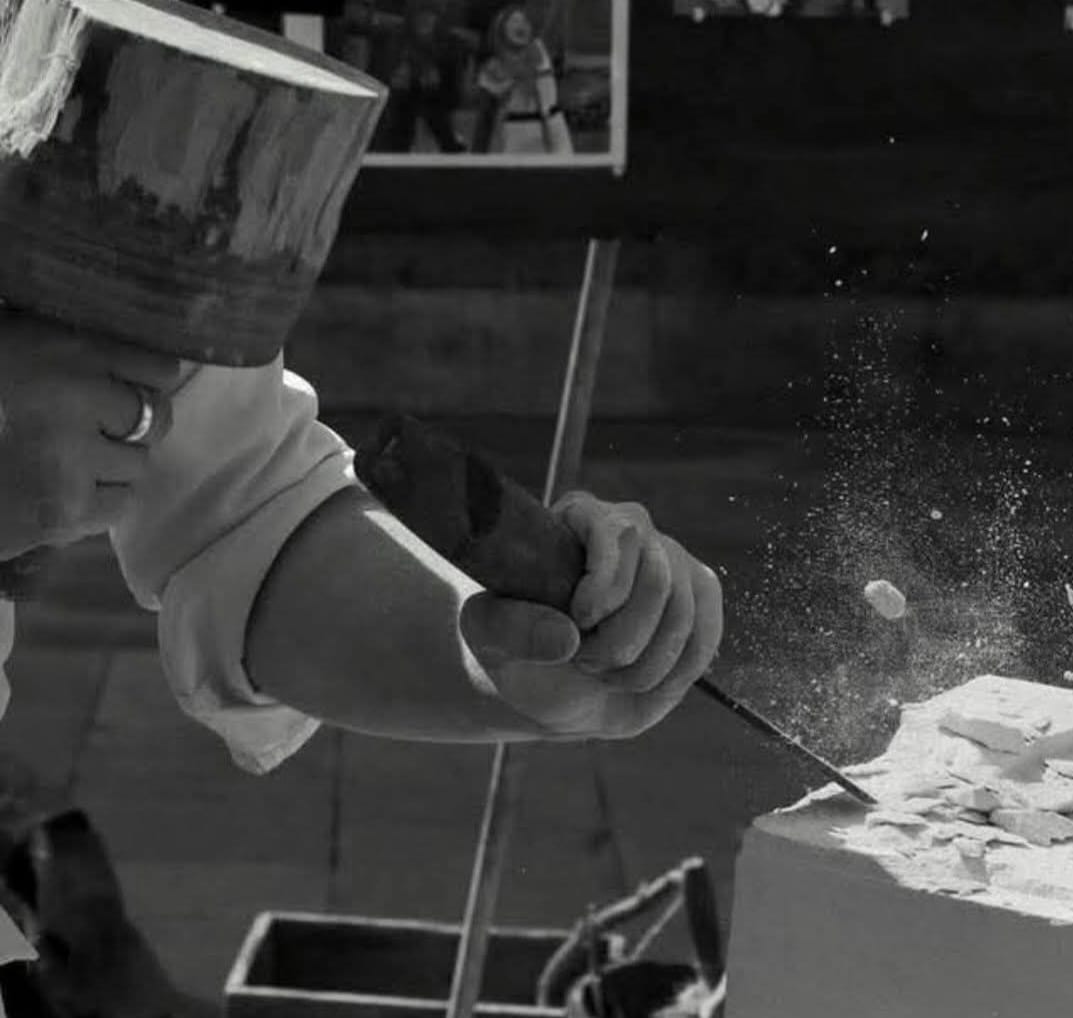
At our retreats, we teach that your “needle” is the point of your tungsten-tipped chisel. The rhythmic strike of the mallet creates a metronome for the soul, drawing the mind into a state of Flow that restores focus and deepens self-awareness.
- The Architecture of Focus: Just as Vermeer blurred the edges of his canvas, the physical act of carving blurs the noise of the boardroom.
- The Dignity of Labour: We frame this rhythmic work as an essential, high-value practice. It is not a chore; it is a “Life Well-Crafted.”
Refining the Architect
Truly seeing is as vital as the strike itself. Vermeer’s canvas is remarkably small—barely larger than a sheet of paper—yet it feels monumental. This teaches us that the quality of our attention, rather than the scale of our task, determines its legacy.
By focusing on the minute grain of the limestone, you are refining the architect of your own focus. You are chiselling away the distractions of the exterior world to reveal the enduring form of your own purpose.
Reflection: The Quality of Your Attention
To bring the quietude of The Lacemaker into your own practice, consider these inquiries:
- Identifying the Blur: In your professional life, what are the “foreground threads” that you must allow to go out of focus so that you can concentrate on your primary craft?
- The Metronome of the Soul: When was the last time you were so immersed in a physical task that the “self” disappeared? How can you recreate that “Geometry of Silence” in your daily routine?
- Monumental Smallness: Vermeer created a masterpiece on a tiny canvas. Are there “small” tasks in your work that deserve a “monumental” level of your attention?
- The Sight of the Carver: In the shed, we learn to see the stone before we strike. Are you looking at your life’s challenges with the “optical truth” of Vermeer, or are you seeing only what you expect to see?
INITIATE QUALIFICATION
This is the formal point of entry for all commissions, residencies, and consultations. To discuss a project or request a place in the Yard, you must first define the scope of your intent.
Begin Qualification


Leave a Reply