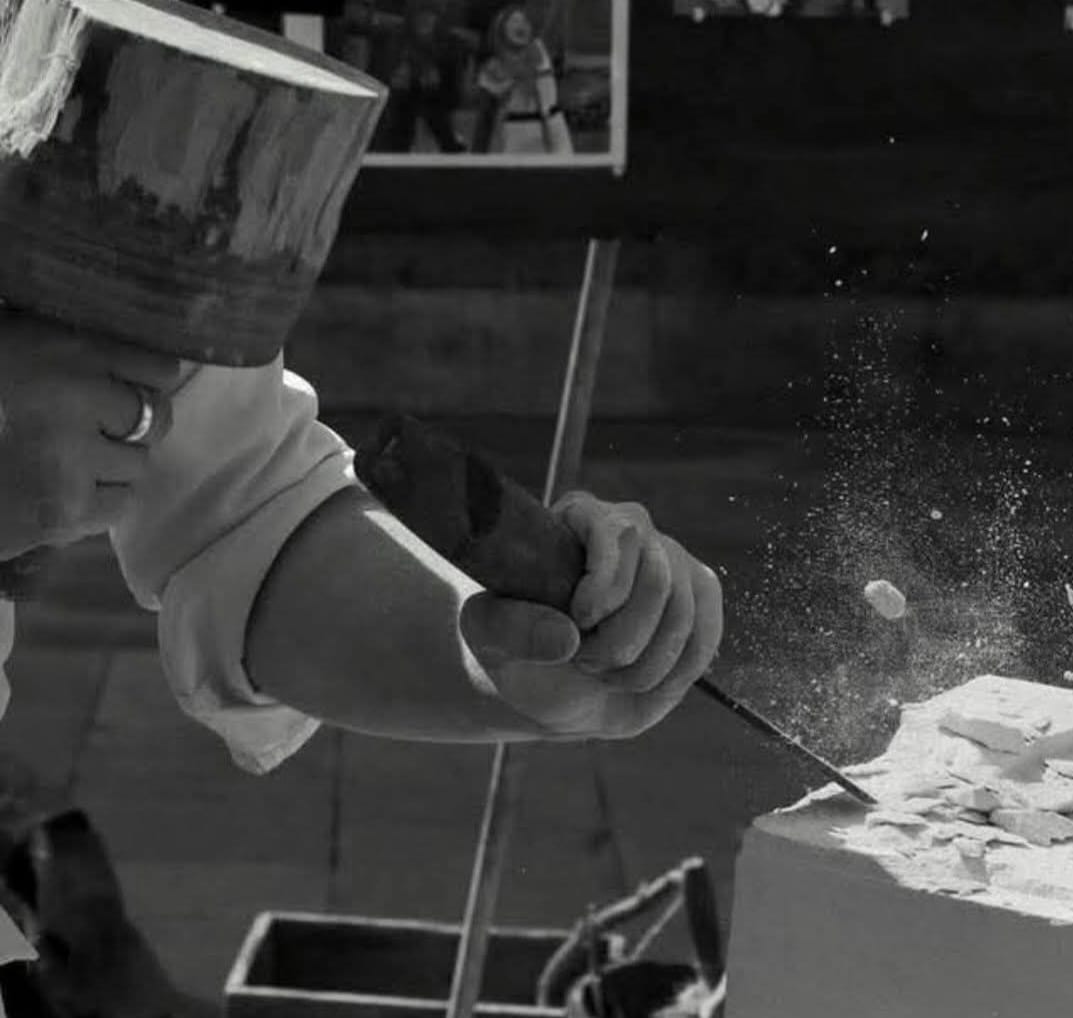
Imagine “the song” as a melody—sometimes beautiful, sometimes discordant—that weaves its way through the fabric of craftsmanship. It carries the wisdom of ancient times and the revelations of the present moment. This isn’t just a romantic notion; it is the very essence of our craft. It is a melody that resonates through each masterpiece, infusing it with a sense of history and depth that goes beyond physical form.
As craftspeople, we are the custodians of a tradition that stretches back through time. Each time we pick up our tools, we add our own chords and themes to an ever-evolving melody. Yet, amidst the new harmonies we introduce, the notes from every age still resound.
To understand the song is to see beyond the surface of what we create. What follows are the notes I have added to that song so far.
An Awkward Beginning
My entry into the world was as distinct as the stones I would later carve. Born in mid-sixties London at the Royal Free Hospital in Islington, I was a breach birth—my mother always said I was an “awkward bugger” even then.
I was born into a world of tea tasters and cigar rollers, the illegitimate son of Anglo-Indian parents. I never knew my father; he left for the Himalayas before I was born, unaware of my existence. He became a famous journalist, a fact I only discovered years after his death through an obituary in the Hindustan Times. We lived parallel lives, both of us “Marmite” characters—people either loved us or hated us.
The London Streets and the Lancashire Soul
We lived just off Chapel Market, a thriving hub of stalls where my family knew everyone. Though my mother and siblings were London-born, we were different. We carried an Anglo-Indian and Northern ancestry that gave us a different moral code than the locals.
The man who was, for all intents and purposes, my father was my grandfather. He was a big, strong Lancastrian who had once sparred with the British boxer Len Harvey. He was a man of indomitable work ethic; I never saw him unshaven or without his teeth. He made a racket when he rowed, but he possessed a profound sense of right and wrong. He was the first note in my song of what it meant to be a man of labor and pride.
The Tower: A Childhood in History
My grandfather worked at the Tower of London until the mid-1970s. On Saturdays, we would take his lunch to him. While other children saw the Tower as a museum, I saw it as a workplace and a home.
The Yeoman Warders and the soldiers would tell me stories, treating me with a kindness that fostered a deep connection to the city. I remember the immense pride I felt during a school visit when a Grenadier Guardsman broke rank to say, “Hello, back again.” In that moment, I wasn’t just a boy from Islington; I was linked to the history of London.
The Responsibility of the Craft
That childhood feeling—the sense of being part of something larger than oneself—is what I carry into my work today. There is a weight of responsibility in knowing that almost everything I carve will still be standing long after I am gone.
Craftsmanship isn’t just about creating objects; it’s about tapping into a legacy. We are the bearers of a song that includes the theory of our practice, the echoes of our culture, and the lessons of our history. Whether I am working on a building near the Adige river or the ceremonial gates of Venice, I am adding my chords to a melody that began centuries before I was born.
The journey of the craft is long, often ambitious, and sometimes the destination is never reached. But for the craftsman, the joy is in the journey itself—staying enthused by the pride of the work and the endurance of the stone.
INITIATE QUALIFICATION
This is the formal point of entry for all commissions, residencies, and consultations. To discuss a project or request a place in the Yard, you must first define the scope of your intent.
Begin Qualification
Leave a Reply