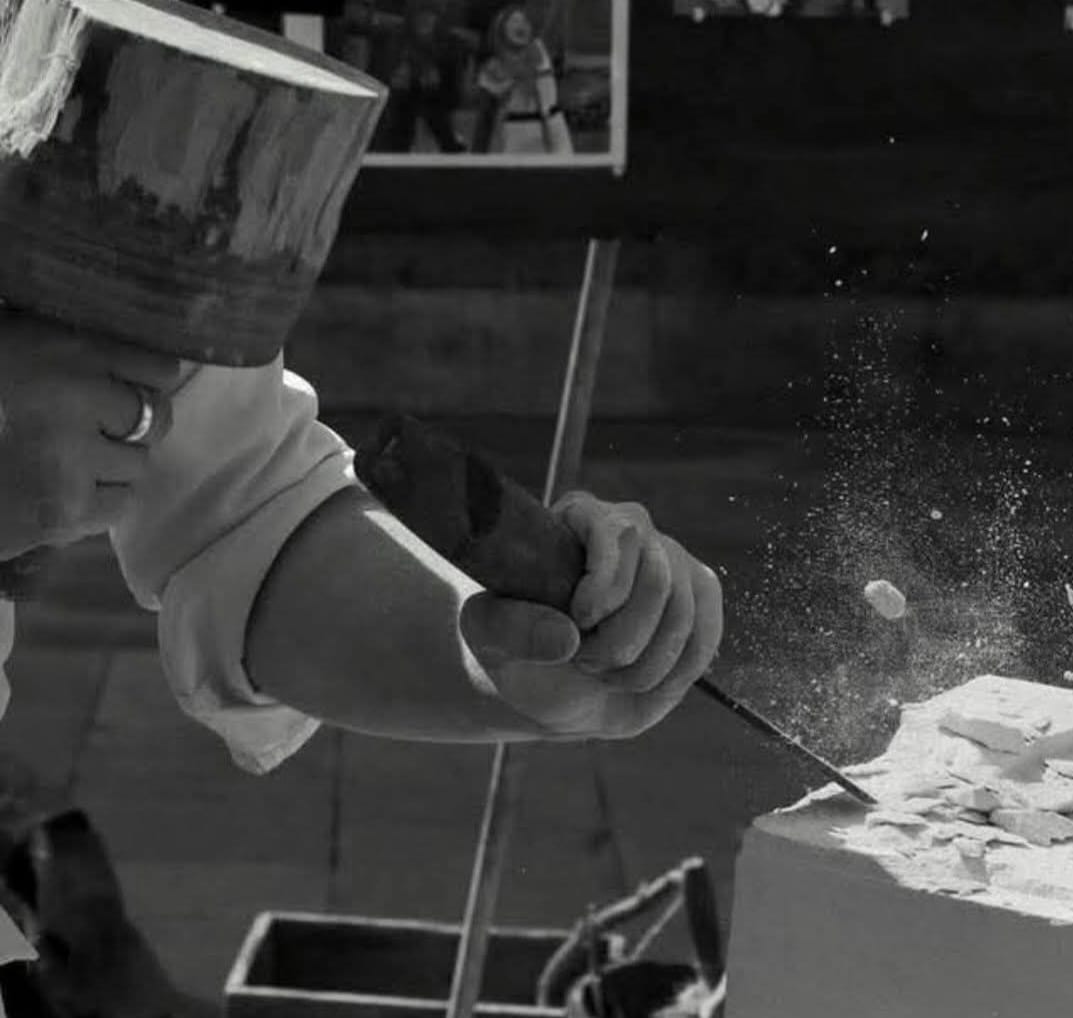
For discerning patrons seeking an unparalleled immersion into the art of stone carving, our exclusive workshops offer an extraordinary journey. We delve into a living tradition, meticulously preserved and honed over centuries, providing not merely practical skills but also a profound theoretical grounding befitting a Court Master in the classical tradition. This is a rare opportunity to connect with an unbroken lineage, where history, tradition, and culture converge to create an experience that is both ancient and remarkably contemporary—a truly human endeavour.

At Court Master Stone Carving, our daily practice is enriched by a tapestry of diverse and profound subjects. Concepts such as Harmonic Proportion, Fóli, Baraka, Eudaimonia, Arete, Gestalt Laws, musical theory, and “The Song” are not abstract ideals; they are vital, guiding principles that inform every stroke of the chisel and every creative decision.
Harmonic Proportion
At its essence, Harmonic Proportion is the deliberate application of mathematical relationships, frequently drawn from musical intervals or natural phenomena like the Golden Ratio (Phi). These relationships are instrumental in achieving balance, beauty, and visual harmony within three-dimensional forms. It dictates that a sculpture’s constituent parts relate harmoniously to one another and to the overall composition, much like notes within a well-constructed chord. For example, the interplay of a figure’s height and width might adhere to a specific ratio, with internal features aligning with underlying geometric principles. The ultimate objective is to evoke an innate sense of correctness and universal appeal, creating a piece that feels, to the viewer, like a perfectly orchestrated visual symphony.
Fóli
Originating from an African worldview, the philosophy “there is no movement without rhythm” is a universally resonant concept. It posits that rhythm is the fundamental pulse of existence, underscoring life’s intrinsic interconnectedness. This notion universally links all things, from the beat of a heart to the cycles of nature, implying that all life flows with an inherent tempo. This idea forms the bedrock of a holistic way of living within many African traditions, where music, dance, daily routines, and celebrations are seamlessly imbued with rhythmic structure. Consequently, it fosters community, articulates complex narratives, and offers both guidance and spiritual connection. Thus, rhythm reveals itself as the very essence and driving force behind all action and being.
Baraka
Baraka, an Arabic term frequently translated as “blessing,” “divine grace,” or “spiritual energy,” holds a profound significance for the craftsperson. It denotes an intangible, deep quality that imbues an object through its mindful creation. When a craftsperson works with exceptional skill, unwavering dedication, profound reverence for materials, and pure intention, their spirit—and indeed, a sense of divine blessing—is woven into the very fabric of the piece. This transcends mere technical prowess; it is about the “soul” or living essence that elevates a simple object into something potent, beautiful, and enduring. Often, such a piece is believed to confer a protective or beneficial influence upon its owner.
Eudaimonia
Eudaimonia translates to “human flourishing” or “living well.” It represents the profound satisfaction derived from deploying one’s unique skills and virtues to their highest potential. Therefore, it transcends the mere pleasure or financial gain obtained from a task. Instead, it embodies the deep sense of purpose discovered through engaging in a craft with excellence, integrity, and a commitment to continuous improvement. For the craftsperson, Eudaimonia is found in meticulous work, in the transformative act of rendering raw materials into beauty, and in the mastery accrued over years of dedicated practice. Ultimately, it manifests in the tangible expression of their creative spirit, leading to a life well-lived through their vocation.
Arete
Arete signifies the unwavering pursuit and achievement of excellence within a craft. It encompasses not only technical skill but also the complete realisation of an object’s inherent potential and function, thereby reflecting the craftsperson’s own virtue and purpose. This necessitates striving for the highest quality in every detail, mastering the chosen materials, and applying knowledge with diligent precision. As a direct consequence, the finished piece embodies both functionality and exquisite beauty, serving as a testament to the maker’s dedication, integrity, and highest capabilities. Ultimately, it reflects a flourishing for both the object and the craftsperson alike.
Gestalt Laws
Gestalt Laws are intuitive principles that illuminate how individuals perceive and interpret visual information. The core tenet is that “the whole is greater than the sum of its parts.” A skilled craftsperson, whether consciously or instinctively, naturally applies these laws. For example, they employ the Law of Proximity by situating related elements in close spatial relation, and they leverage the Law of Similarity by repeating textures or shapes to foster harmony. Furthermore, they ensure Continuity for seamless visual flow, capitalise on Closure to allow viewers to complete implied forms, and master Figure/Ground to ensure key elements command attention. By expertly manipulating these innate tendencies, the craftsperson expertly guides the eye and crafts unified, impactful pieces.
Musical Theory
Musical theory serves as the structural anatomy of sound, providing the foundational principles for deliberately shaping auditory experiences. Much like a sculptor comprehends the properties of their chosen materials, musical theory offers a comprehensive framework for understanding notes, harmonies, rhythms, and forms. It illuminates how elements such as notes coalesce across dimensions like melody and harmony, generating tension, emotion, and cohesive form over time. This parallels a sculptor’s masterful manipulation of space, mass, and line to create a resonant object. Ultimately, the theory itself is not the music, but rather the foundational knowledge that empowers the manipulation of sound, mirroring the sculptor’s mastery over their chosen medium.
The Song
“The Song” is a concept central to our craft, serving as a powerful metaphor for knowledge and memories that transcend the confines of time. Imagine “the song” as a melodic thread—sometimes harmonious, occasionally dissonant—that weaves through the very fabric of craftsmanship, carrying ancient wisdom and present revelations. This melody resonates not only through each masterpiece crafted by Stephen but also through every student trained, imbuing them with a profound sense of history and depth that extends far beyond the physical form.
The Expanded Senses of Court Craft
While conventional understanding often limits the senses to five (sight, hearing, smell, taste, and touch), the concept of “court craft senses” draws from a broader interpretation of perception. Neuroscientists and psychologists now acknowledge a multitude of ways our bodies interact with and perceive the world, extending well beyond these basic five.
Here are some examples of these expanded senses that are integral to the mastery taught at Court Master Stone Carving:
Physical/Internal Senses
- Proprioception: The profound awareness of the precise position and movement of one’s body parts without the need for visual input. This is the intrinsic sense that allows one to touch their nose with closed eyes.
- Equilibrioception (Balance): The sophisticated sense of balance and spatial orientation, meticulously controlled by the vestibular system located within the inner ear.
- Interoception: The subtle perception of stimuli originating from within the body, encompassing sensations such as one’s heartbeat or the rhythm of breathing.
- Kinaesthesia: The discerning sense of movement and the precise effort required in the execution of actions.
- Stretch Reception: The ability to sense the specific stretch or tension within muscles, joints, and other connective tissues.
- Pressure: The nuanced ability to differentiate between light and deep pressure applied to the skin.
- Vibration: The subtle detection of vibrations through the skin, crucial for understanding material resonance.
Temporal and Environmental Senses
- Chronoception: The innate perception of the inexorable passing of time, vital for rhythm and pacing in carving.
- Space/Proximity Sense: A keen awareness of one’s own position in relation to objects and individuals within the surrounding environment.
- Electromagnetism (Limited): While not as acutely developed as in some species, humans possess a limited, though often unconscious, capacity to detect electromagnetic fields.
Higher-Order and Conceptual Senses
Beyond the purely physical, some expanded lists delve into more abstract “senses” that are inextricably linked to cognitive and emotional processes, all of which contribute to the holistic development of a Court Master:
- Sense of self: A deep understanding of one’s own identity and capabilities.
- Sense of humour: The appreciation for and expression of wit and amusement, often reflecting a broader perspective.
- Sense of community/belonging: The feeling of connection and shared purpose within a group.
- Aesthetic sense: A refined appreciation for beauty in its myriad forms, encompassing music, art, and the natural world.
- Intuition: The ability to understand something immediately, without the need for conscious reasoning.
- Sense of fear/dread: A primal awareness of potential threat or danger, crucial for respect of materials and tools.
- Sense of morality/ethics: The inherent understanding of right and wrong, guiding integrity in creation.
We invite you to discover how these profound principles intertwine to elevate the ancient craft of stone carving into an art form that is truly timeless. Would you like to explore our workshop availability or delve deeper into any of these philosophical tenets?
INITIATE QUALIFICATION
This is the formal point of entry for all commissions, residencies, and consultations. To discuss a project or request a place in the Yard, you must first define the scope of your intent.
Begin Qualification
Leave a Reply